
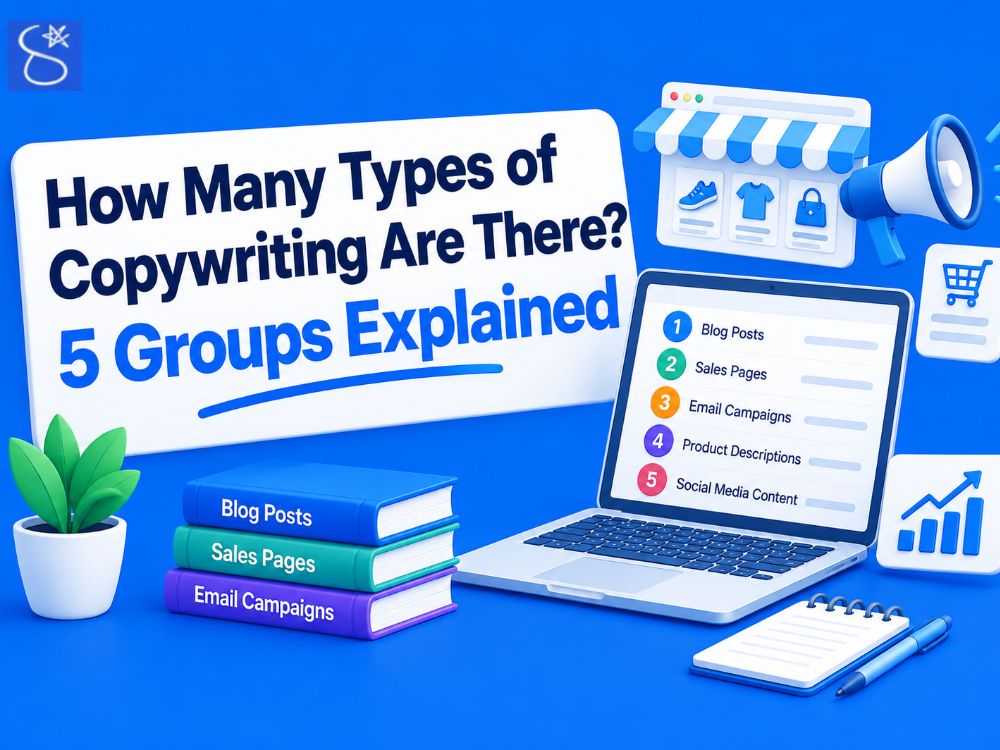
As you know, copywriting is the skill of writing words that make people take the action you want. In this digital era, every business needs copywriting to convey its message to its customers.
But do you know copywriting is not one theory or rule? There are many types of copywriting. It depends on the platform, audience, and business goals. Examples include direct response copywriting, SEO copywriting, social media copywriting, and email copywriting. Before you pick a type of copywriting, you need to know each one has a different purpose.
I can confidently say most beginners are confused about how many types there are. That’s how I felt when I started learning copywriting myself. Then I sat down to research everything. First, I made a complete list of all available copywriting types, and I watched YouTube videos to see what other people were saying about them.
In the end, my research led me to 5 main groups of copywriting, and I am 100% sure this will create a logical system in your mind so you can easily understand how many types of copywriting there are.
In this article, you will not find a complete list of all copywriting; instead, you will find the first 5 groups, then the other types of copywriting. These five groups logically categorize other types of copywriting. At the end of the article, you will say, “Yeah, this is what I need to understand,” and if you say exactly this, make sure to comment so I can also know.
How Many Types of Copywriting Are There?
By the way, we can say there are 20+ types of copywriting; I just want to show you the complete list of types I found during my research. This way, you can see how confusing the list is and why 5 groups make the most sense.
Almost All Types of Copywriting
Traditional & Print
- Direct Response Copywriting
- Ad (Advertising) Copywriting
- Print Copywriting
- Catalog Copywriting
- Brochure & Flyer Copywriting
- Billboard Copywriting
- Radio Ad Copywriting
- TV Commercial Scriptwriting
- Infomercial Copywriting
Digital & Web
- SEO Copywriting
- Website Copywriting
- Landing Page Copywriting
- Squeeze Page Copywriting
- Sales Page Copywriting
- Video Sales Letter (VSL) Copywriting
- Email Marketing Copywriting
- Autoresponder Copywriting
- Newsletter Copywriting
- Cart Abandonment Copywriting
- E-commerce Copywriting
- Product Description Copywriting
Social Media & Content
- Social Media Copywriting
- LinkedIn Copywriting
- Paid Social Ad Copywriting
- Blog Post Copywriting
- Native Advertising Copywriting
- Advertorial Copywriting
- Case Study Copywriting
- Whitepaper Copywriting
- E-book Copywriting
Brand, Product & Tech
- Brand Copywriting
- Slogan & Tagline Copywriting
- Jingle Copywriting
- UX (User Experience) Copywriting
- Microcopy
- Product-Led Growth (PLG) Copywriting
- App Store Optimization (ASO) Copywriting
- Technical Copywriting
- SaaS Copywriting
- Onboarding Sequence Copywriting
Corporate & Professional
- B2B (Business-to-Business) Copywriting
- B2C (Business-to-Consumer) Copywriting
- Corporate Copywriting
- PR (Public Relations) Copywriting
- Press Release Copywriting
- Speechwriting
- Presentation Copywriting
- CSR (Corporate Social Responsibility) Copywriting
- Internal Communications Copywriting
- Crisis Management Copywriting
Industry & Niche
- Financial Copywriting
- Crypto & Web3 Copywriting
- Medical Copywriting
- Healthcare Copywriting
- Pharmaceutical Copywriting
- Legal Copywriting
- Real Estate Copywriting
- Travel & Hospitality Copywriting
- Fashion & Luxury Copywriting
- Fitness & Wellness Copywriting
- Non-Profit Copywriting
- Fundraising Copywriting
- Political Campaign Copywriting
Advanced & Psychological
- Psychological Copywriting
- Neuro-Copywriting
- Emotional Copywriting
- Narrative Copywriting
- Storytelling Copywriting
- Ghost-Copywriting
- AI-Assisted Copywriting
- Transcreation Copywriting
- Conversion Rate Optimization (CRO) Copywriting
- Affiliate Marketing Copywriting
Now tell me which copywriting you are going to choose. Have you understood properly? I didn’t understand anything, so I made a plan that logically gave me a copywriting group that was very easy to understand.
These five groups I am going to describe below aren’t just random. You can see in this the entire journey of digital marketing: when a person starts his business online, from there to the end, where it ends or where its progress begins, there is a journey of copywriting.
However, this group doesn’t cover every type of copywriting; some belong in other groups, but I am going to cover the most important and popular type. The most popular type of copywriting is the one you can use to make money every month.
5 Groups of Copywriting by SEOZA
Before I introduce the five categories, let me set the scene: imagine someone launching a business, a startup. From the moment they start, they need a website and a presence on social media platforms. That is where website copywriting comes in first, followed by social media copywriting. Here’s what they are;
When You Start an Online Business?
1: Website Copywriting
Website copywriting is a form of copywriting that involves creating content for a website’s pages. These typically include the
- Home page
- About page
- Services page
- Contact Us page
Other pages may exist depending on the site; however, the above are the standard, universal pages. Depending on the website, there may also be additional pages such as product pages, portfolio pages, or milestone pages.
2: Social Media Copywriting
Let’s discuss social media copywriting. When a business launches, it requires a social media presence alongside a website, creating a need for social media copywriting. This involves crafting content, such as Instagram captions, LinkedIn posts, and Facebook post descriptions.
Each is tailored to its platform to showcase the brand’s presence and identity. Whether the brand is a startup or an established, growing enterprise, social media copywriting is essential for every business.
Also, if you know how to manage social media platforms, that’s a big advantage; you can manage a client’s presence by leveraging your understanding of algorithms, tracking, performance metrics, and copywriting.
If you are interested in learning social media copywriting specifically, you could choose a niche like LinkedIn ghostwriting. However, if you choose a specific platform, you should also start offering services related to that platform’s algorithm; this will position you as a specialist in managing that particular platform.
When Your Organic Traffic Starts to Grow
Now, let’s discuss the next step: once your startup starts generating organic traffic through social media copywriting, personal branding, and website SEO keyword optimization, the logical progression is to move into paid marketing. This involves using platforms like social media, Google, and YouTube to run advertisements; Google Ads and Meta Ads are particularly popular choices in this space.
3: Ad Copywriting
Ad copywriting falls into specific types, primarily copy designed for social media ads (such as Meta ads, covering Facebook, Instagram, WhatsApp, and other Meta platforms) and Google ads (including those on Google itself and YouTube).
For YouTube and video ads, I further classify ad copywriting into two categories: text-based ad copywriting and video-based ad copywriting (which involves writing scripts for video ads). Overall, ad copywriting is essentially the process of selecting words that prompt the reader to take immediate action.
When You Have a Large Audience and Email List
Now, let’s discuss the business stage where you have a substantial audience and an associated email list. This means your business has reached a level where you have successfully built an audience, possessing a list of a thousand or more email addresses. Now is the time for email copywriting, a strategy that brings that same audience back to you repeatedly.
4: Email Copywriting
Email copywriting involves writing emails specifically designed to prompt the audience to take a particular action. Emails are generally categorized into two types: “cold” and “warm.” Cold email copywriting targets an audience with no prior knowledge of our brand. Conversely, warm email copywriting targets an audience already familiar with our brand or that has previously purchased from us.
If someone chooses to specialize in email copywriting, they can combine it with email marketing to build a more comprehensive skill set and earn income in dollars. However, focusing solely on email copywriting is also a valid choice, as the field encompasses a wide range of activities, such as writing newsletters and crafting emails for diverse audiences and purposes, making it a broad and sufficient skill in itself. That said, knowing email marketing strategies and processes can strengthen your email copywriting and drive even better results.
Every E-commerce Business Needs This
What I am talking about now is a necessity for every business, especially e-commerce businesses selling physical products, and that is product description copywriting.
5: Product Description Copywriting
Product description copywriting involves writing details about a specific product, such as its features- but simply listing features isn’t enough; highlighting the benefits of those features, and even the secondary benefits derived from them, is a key skill for creating high-converting descriptions.
However, it is best to combine this with other skills, such as website copywriting. Since product description writing is a highly specialized niche, you can offer your services by learning it alongside website copywriting or general content writing.
For now, I am working on these 5 types of copywriting; however, if you want to see all types of copywriting and their definitions, you can copy the names from the list above and search for them separately. And you can also see details below. But first, let’s look at which type of copywriting pays the most.
What Type of Copywriting Is Most in Demand and Pays the Most?
The demand for any type of copywriting depends entirely on its ability to generate measurable revenue or customer growth for your client’s business. The more profit your client gets, the more they will pay you. In today’s competitive era, clients don’t pay simply for creative wording; they pay for copy that drives results and delivers high ROI.
That’s why direct response copywriting and high-level SEO copywriting are in high demand. You can understand that copy written to increase sales is a high-paying skill. However, other copywriting types, such as email copywriting, social media copywriting, and web copywriting, are also in demand, but direct response is one of the highest-paying skills because it directly converts readers into paying customers.
Here’s a table comparing the most in-demand copywriting types.
| Copywriting Type | What the Work Involves | Typical Project | Fee Range (USD) |
| Direct Response | Sales pages and video sales letters written to get an immediate sale | Online sales page (single promotion) | 3,500–5,000+ (beginner), 7,500–12,500+ (intermediate), up to $25,000+ (highly skilled), plus royalties |
| Direct Response | Long-form video sales letter script | $5,000+, based on length | |
| SEO | Blog posts, articles, and pillar content written to rank and bring organic traffic | Blog post (300–1,000 words) | 250–800 per post |
| SEO | Article (1,200–2,000+ words) | 250–1,000 | |
| SEO | Pillar post (4,000+ words) | 500–2,500 per post | |
| B2B | Case studies and white papers that explain a product and help business buyers decide | Case study (800–1,200 words) | 1,200–2,000 |
| B2B | White paper (5–10 pages) | 2,000–10,000 | |
| Sales emails, automated sequences, and newsletters | Stand-alone email | 250–2,000 | |
| Autoresponder/funnel series | 100–1,000 per email | ||
| E-newsletter | 800–2,000 per issue |
How to Choose the Right Type of Copywriting for You
Choosing the right type of copywriting isn’t about picking the one that pays the most on paper. It is about finding the sweet spot where your natural strengths meet what businesses are actually willing to pay for. Think of it like choosing a career path in medicine: you can be a general physician, or you can specialize as a surgeon. Specialists always command higher respect and bigger paychecks.
To figure out where you fit in, ask yourself these three foundational questions:
Do you love psychology and human behavior? If you are fascinated by why people buy things and love the thrill of making an immediate sale, Direct Response or Email Marketing is your calling. You will spend your days figuring out what makes consumers tick.
Do you enjoy deep research and teaching through writing? If you like deep-diving into complex topics and writing long, valuable guides that rank on Google, look into SEO & Content Strategy. This path is perfect for analytical minds who love building long-term traffic.
Are you naturally tech-savvy and business-minded? If you can understand how software works and explain it to a CEO without using confusing jargon, B2B SaaS and Tech Copywriting is an incredibly lucrative goldmine for you.
My Advice to You as a Beginner
Do not pressure yourself to choose a permanent niche on day one. When you are just starting out, be a generalist first. Take on a few different projects, write a blog post, draft an email sequence, and try a basic sales page.
Within three to six months, you will naturally realize which tasks feel like a chore and which ones you actually enjoy. Once you find what you like, double down, build a specialized portfolio, and watch your rates skyrocket.
Other Types of Copywriting
Other Types of Copywriting
The five groups above are what most businesses need first. But as a business grows, it needs a different kind of copy at each new stage. So I have arranged the remaining types in the same way, by the stage where a business usually needs them.
When You Are Building Your Brand Identity
- Brand Copywriting: The copy that gives a brand its personality. It decides how the brand talks, what it stands for, and the story it tells everywhere.
- Slogan & Tagline Copywriting: A short line people remember a brand by. Just a few words that say what the brand is about.
- B2B Copywriting: Copy for a business that sells to other businesses. The reader is a decision-maker, so the copy focuses on facts, proof, and results.
- B2C Copywriting: Copy for a business that sells to everyday people. It is shorter, simpler, and speaks more to feelings.
When You Want Free Traffic and Trust
- SEO Copywriting: Copy written so a page shows up on Google when people search a keyword, and still reads well for the person who opens it.
- Blog Post Copywriting: Blog articles that answer people’s questions and then point them to the next step, like signing up or buying.
- E-book Copywriting: A long guide on one topic. Most businesses give it away for free in exchange for the reader’s email address.
- Whitepaper Copywriting: A detailed report backed by research. It explains a problem and shows how to solve it. Mostly used by B2B companies.
- Case Study Copywriting: A real customer’s success story. It shows the problem they had, what you did, and the results they got.
When You Want Visitors to Become Buyers
- Direct Response Copywriting: Copy that asks the reader to do something right now: buy, sign up, call, or click.
- Landing Page Copywriting: Copy for a single page with one offer and one button. People usually land on it after clicking an ad or an email.
- Squeeze Page Copywriting: A very short page with one goal: getting the visitor’s email address, usually by offering a freebie.
- Sales Page Copywriting: A page written to sell one product or service. It explains the problem, the offer, and the proof, and answers the buyer’s doubts.
- Video Sales Letter (VSL) Copywriting: A sales page in video form. You write the script, and the video does the selling.
- E-commerce Copywriting: All the words inside an online store, such as category pages, banners, product pages, and checkout messages.
- Conversion Rate Optimization (CRO) Copywriting: Improving copy that already exists. You test different headlines, buttons, and lines to see which one gets more people to act.
When Your Ad Budget Grows Beyond Meta and Google
- Native Advertising Copywriting: Paid ads that look like the surrounding content, so they don’t feel like ads.
- Advertorial Copywriting: An ad that is written like a news or magazine article.
- Affiliate Marketing Copywriting: Promoting someone else’s product through reviews, comparisons, or emails. You earn a commission when someone buys through your link.
- Print Copywriting: Copy for anything printed, like newspapers, magazines, and letters sent by post.
- Brochure & Flyer Copywriting: A flyer is a single sheet that promotes one offer or event. A brochure is a folded booklet that tells more about the business.
- Catalog Copywriting: Short descriptions for many products listed together in one catalog.
- Billboard Copywriting: A handful of words on a big outdoor board. People pass it in seconds, so the message has to land instantly.
- Radio Ad Copywriting: Scripts for ads that people only hear. No pictures, so the words and the voice do all the work.
- TV Commercial Scriptwriting: Scripts for TV ads. You write what people will see and hear in a short ad.
- Infomercial Copywriting: Scripts for long TV ads that show a product in action and ask viewers to order right away.
- Jingle Copywriting: The words of a short, catchy ad song that keeps the brand stuck in your head.
When Your Email List Runs on Automation
- Autoresponder Copywriting: Emails you write once, and the system sends them automatically. A welcome email after signup is a common example.
- Newsletter Copywriting: Regular emails, weekly or monthly, that keep your subscribers updated and connected with you.
- Cart Abandonment Copywriting: Reminder emails or messages for people who added a product to their cart and left without paying.
- Onboarding Sequence Copywriting: A series of messages that helps a new customer get started with the product, step by step.
When Your Product Is an App or Software
- UX Copywriting: The words inside an app or website that help people use it, like menus, instructions, and error messages.
- Microcopy: The tiny bits of text you barely notice, such as the words on a button, a hint under a form field, or a small pop-up tip.
- SaaS Copywriting: Copy for software that people pay for monthly or yearly. It covers the homepage, pricing page, and feature pages.
- Product-Led Growth (PLG) Copywriting: Copy for products people can try for free first. The words inside the product encourage them to move to the paid plan.
- App Store Optimization (ASO) Copywriting: The app name, description, and keywords on the App Store or Google Play, written so people can find and download the app.
- Technical Copywriting: Explaining a complicated product in clear words for people who already know the field.
When Your Startup Becomes a Company
- Corporate Copywriting: Formal writing that represents the company, like the company profile, annual report, and mission statement.
- PR Copywriting: Copy that builds a good public image and gets the company talked about in the media.
- Press Release Copywriting: An official news announcement sent to journalists, written in a fixed format.
- Speechwriting: Writing speeches that a founder, executive, or public figure will deliver.
- Presentation Copywriting: The words on the slides of a presentation or pitch deck.
- CSR Copywriting: Copy that tells people what the company is doing for society and the environment.
- Internal Communications Copywriting: Writing for the company’s own employees, like announcements, memos, and staff newsletters.
- Crisis Management Copywriting: The statements a company gives when something goes wrong, written carefully so people don’t lose trust.
When You Enter a New Country or Language
- Transcreation Copywriting: Rewriting copy for another language and culture. You don’t translate word for word. You keep the same feeling and effect.
When You Choose an Industry
These are not stages of the journey. They are niches. The skill stays the same, and only the industry changes.
- Financial Copywriting: Copy for banks, investment firms, insurance, and fintech companies. Every claim has to be accurate.
- Crypto & Web3 Copywriting: Copy for crypto exchanges and blockchain projects. The job is to explain difficult technology in simple words.
- Medical Copywriting: Scientific health content, often written for doctors and other healthcare professionals.
- Healthcare Copywriting: Copy for hospitals, clinics, and health services, written for patients.
- Pharmaceutical Copywriting: Copy for medicines and drug companies, written under strict rules.
- Legal Copywriting: Copy for law firms that turns legal language into words a client can understand.
- Real Estate Copywriting: Property listings and marketing copy for agents and agencies.
- Travel & Hospitality Copywriting: Copy for hotels, airlines, tour companies, and travel destinations.
- Fashion & Luxury Copywriting: Copy for clothing and premium brands. It sells style, status, and a feeling more than the product itself.
- Fitness & Wellness Copywriting: Copy for gyms, trainers, supplements, and wellness brands.
- Non-Profit Copywriting: Copy for charities that explains their mission and the difference they make.
- Fundraising Copywriting: Copy that asks people to donate, like appeal letters and donation pages.
- Political Campaign Copywriting: Slogans, speeches, emails, and ads written to win votes for a candidate or party.
Copywriting Styles That Work at Every Stage
These are not separate jobs either. They are ways of writing that you can use in any type of copywriting above.
- Psychological Copywriting: Copy that uses how people naturally think and decide. Showing reviews or a limited-time offer are two common examples.
- Neuro-Copywriting: Copy based on what brain science says about how people pay attention and make decisions.
- Emotional Copywriting: Copy that speaks to feelings first, like fear, joy, or the need to belong.
- Storytelling & Narrative Copywriting: Copy that delivers the message through a story with a character, a problem, and a solution.
- Ghost-Copywriting: You write the copy, and it gets published under your client’s name.
- AI-Assisted Copywriting: Using AI tools for research, drafts, and ideas, while a human guides and edits the final copy.
FAQ’s
Is legal writing a type of copywriting?
No. Writing contracts, briefs, and legal documents is a separate field that requires legal training. However, writing the marketing websites, ads, or brochures for law firms is considered copywriting.
Can a copywriter focus on more than one type?
Yes. You can absolutely combine two complementary skills, such as Email Marketing and Direct Response. Just avoid offering too many unrelated types, or clients may view you as a generalist rather than an expert.
What is the difference between copywriting and content writing?
The core difference is the ultimate goal. Copywriting is short-form writing designed to drive an immediate action or sale (e.g., ads, sales pages). Content writing is long-form writing designed to educate, entertain, and build long-term trust (e.g., blog posts, guides).